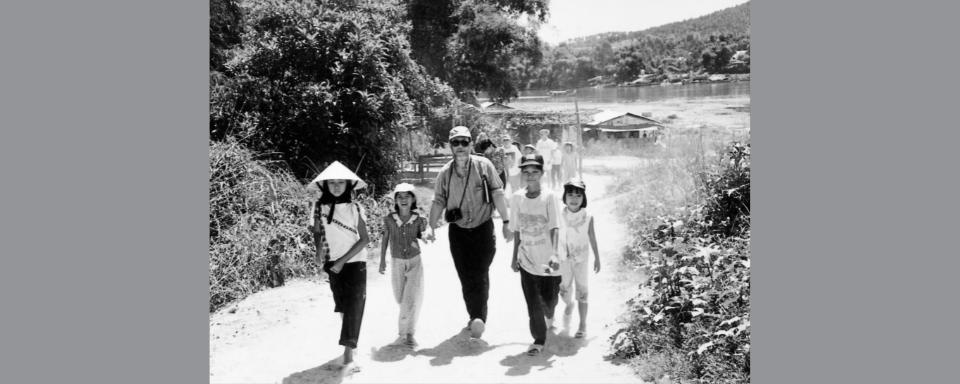
Q&A with Lon Holmberg, author of CROSSING THE PASS OF CLOUDS
to mark the 50th anniversary of the Fall of Saigon
April 30 marks the 50th anniversary of the Fall of Saigon, which brought an end to the Vietnam War. To remember the day, and those that served, the University Press of Mississippi is sharing an exclusive interview with Lon Holmberg, author Crossing the Pass of Clouds: An Army Photographer’s Vietnam Journal.
Crossing the Pass of Clouds presents a captivating and deeply personal account of Holmberg’s experiences during his service as an army photographer in Vietnam in 1971. Included are 147 black-and-white pictures and a series of vignettes written by Holmberg.
UPM: When did you start taking photos?
LH: My dad bought me a Brownie Holiday in 1953, the year they came out, when I was nine. It was very compact — 3” x 3.5” x 2.5”. A small viewfinder on top of the camera allowed you to compose the image. It had only one shutter speed (1/30 - 1/40 of a second). Dad said if more than half of my first roll of 127 film came out, he’d buy me another roll. They did, and I’ve been taking pictures ever since.
UPM: As a photographer, what do you hope to illuminate / illustrate with your work?
LH: I hope to show aspects of daily life in Vietnam not widely covered by the media. For example, I spent time at a firebase, I also covered MACV Headquarters as General Creighton Abrams’s photographer, I visited indigenous tribal people on stories for The Observer, the Army’s weekly newspaper in Vietnam, and I photographed Saigon whenever I could.
UPM: Why did you decide to write Crossing the Pass of Clouds?
LH: Just before shipping out, I visited my friend and novelist George Garrett in Charlottesville, VA. As we sat listening to Pink Floyds’s Atom, Heart, Mother, he said I should make a book about my experience in Vietnam. However, life intervened. I brought back about 8,000 negatives and made many prints; I wrote and revised. Slowly the book began to take form. I thought it could contribute to a broader understanding of the war.
UPM: Do you have a favorite image in the book?
LH: My favorite picture was made in an indigenous community near the Cambodian border. In the center of community bustle, a young girl smiled at me. I’m not sure she knew what photography was, but she saw me smiling at her and she liked being noticed. It was a sweet cross-cultural moment.
UPM: When you look back at the collection, what do you see as a viewer — not the creator?
LH: I see a visual narrative going from the port of New York to the port of Saigon, an amazing range of people, events both serious and silly, and, finally, I see a young Vietnamese scientist, who calls me and my wife her American grandparents, defend her Ph.D. in Nuclear Particle Physics at the University of Virginia. Truly a fascinating journey!
UPM: What would you like people to gain or experience from your book?
LH: I’d like people to gain a picture of Vietnam as a beautiful country with a rich history in which the war plays a part, but only a part of its long history. In addition to seeing the country as larger than the war, I hope viewers are able to experience the book as if it were a documentary film, and to put themselves inside the frame.
Photo by Charles Shenk


Comments