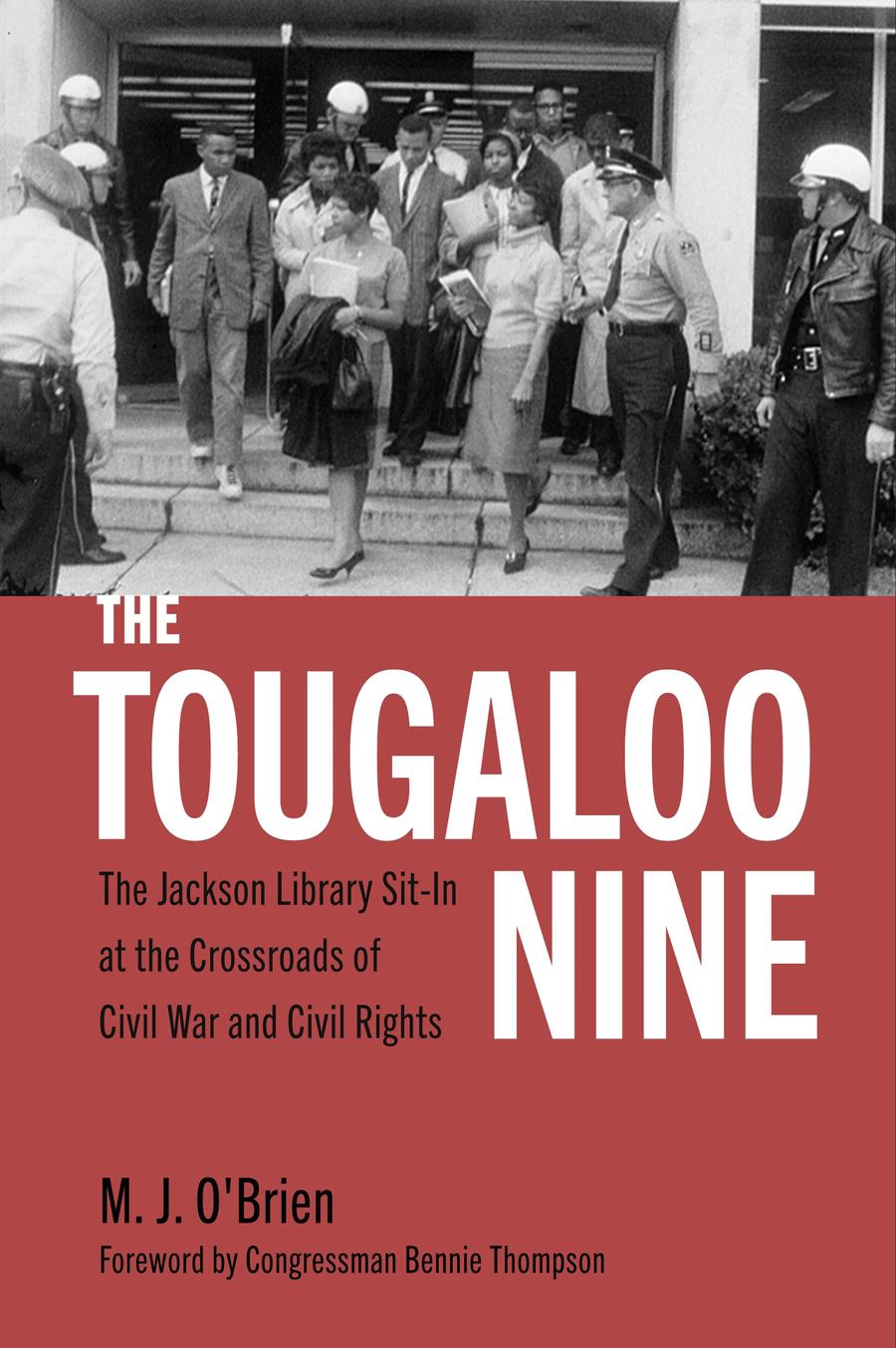
The Tougaloo Nine
The Jackson Library Sit-In at the Crossroads of Civil War and Civil Rights
The stunning history of the first student-led, direct-action civil rights demonstration in the state of Mississippi
Description
During a dramatic three-day period in March 1961, nine students from historically Black Tougaloo College staged sit-ins at the all-White Main Library in Jackson, Mississippi. The students conducted their protest and were arrested, held in jail overnight, and convicted of “breach of peace”—the first time that charge had ever been brought in a Mississippi courtroom. Meanwhile, students at Jackson State College held sympathy protests, and the police responded harshly on both day one and day two. On day three, police attacked a peaceful crowd of observers awaiting the trial’s outcome, using attack dogs, billy clubs, and tear gas to disperse the crowd, one of the first known uses of police dogs on a peaceful gathering during the civil rights era.
The protests occurred while Mississippi was preparing to celebrate the one hundredth anniversary of the state’s secession from the Union and the commencement of the Civil War. The library sit-in preempted the state’s Confederate extravaganza that brought more than thirty thousand mostly White observers into the streets of Jackson while the students sat in jail, further inflaming passions on both sides.
In The Tougaloo Nine, M. J. O'Brien delves into Tougaloo College’s culture of resistance, Mississippi’s determination to preserve segregation, and the early stirrings of the student movement in Jackson. Through numerous interviews and years of detailed research, O'Brien tells the stories of these courageous African American students. He also explores the personalities leading the charge on both sides, including Mississippi NAACP leader Medgar Evers; Tougaloo professors and administrators Ernst Borinski, Reverend John Mangram, and President A. D. Beittel in one camp; and Governor Ross Barnett, Citizens’ Council leader William Simmons, and Jackson Mayor Allen Thompson in the other. Altogether, The Tougaloo Nine presents the stunning picture of those who risked their lives and future livelihoods to fight for full social and political equality in Mississippi, USA.
Reviews
"While history often acknowledges the significance of the 1960 Greensboro sit-ins and the subsequent founding of the Student Nonviolent Coordinating Committee, The Tougaloo Nine places a small, private Black college in the heart of Jim Crow Mississippi at the center of the era’s radicalism and social change. No scholar has previously provided such detailed analysis of what is arguably one of the most pivotal moments in Mississippi’s civil rights history."
- Daphne Chamberlain, chief program officer at the Emmett Till Interpretive Center
"M. J. O’Brien’s delightful account of ‘the Tougaloo Nine’ is beautifully written and provides a compelling portrait of Mississippi’s nine sit-in pioneers and the all-Black worlds that raised, nurtured, and sustained them. By juxtaposing the Tougaloo student protests with Mississippi’s celebration of the Confederacy’s Lost Cause mythology, O’Brien also reminds us why the battle for civil and human rights was so fraught and so essential. By focusing on this one small piece of the Black freedom movement, O’Brien brings to life crucial themes with nuance and complexity. This is a wonderful, worthwhile book that will appeal to newcomers, specialists, and everyone in between."
- Emilye Crosby, author of A Little Taste of Freedom: The Black Freedom Struggle in Claiborne County, Mississippi
"I wasn’t sure that there was anything left to know about civil rights in Mississippi, but The Tougaloo Nine proved me wrong. M. J. O’Brien’s book is not just captivating; it adds texture and context to well-known stories and brings to light never-heard or under-heralded stories, giving important nuance to narratives of the freedom struggle."
- Crystal R. Sanders, author of A Forgotten Migration: Black Southerners, Segregation Scholarships, and the Debt Owed to Public HBCUs
"With his book, The Tougaloo Nine, M. J. O’Brien provides an incredible service for both civil rights scholars and any reader interested in the history of the modern movement in America. Not only does O’Brien lift up a lesser-known but essential story of determined young activists during the earliest stage of the nonviolent, direct-action movement in Mississippi, he helps us to understand how a small group of local people can usher in groundbreaking social change in the face of overwhelming resistance. He also connects the current moment of turmoil in American society to that past and shows us how the activism of the 1960s never vanished and continues to inform movements for social justice and civil rights to this day."
- Robert Luckett, professor of history and director of the Margaret Walker Center and COFO Civil Rights Education Center at Jackson State University
"An amazing and historic piece of work!"
- Congressman Bennie G. Thompson