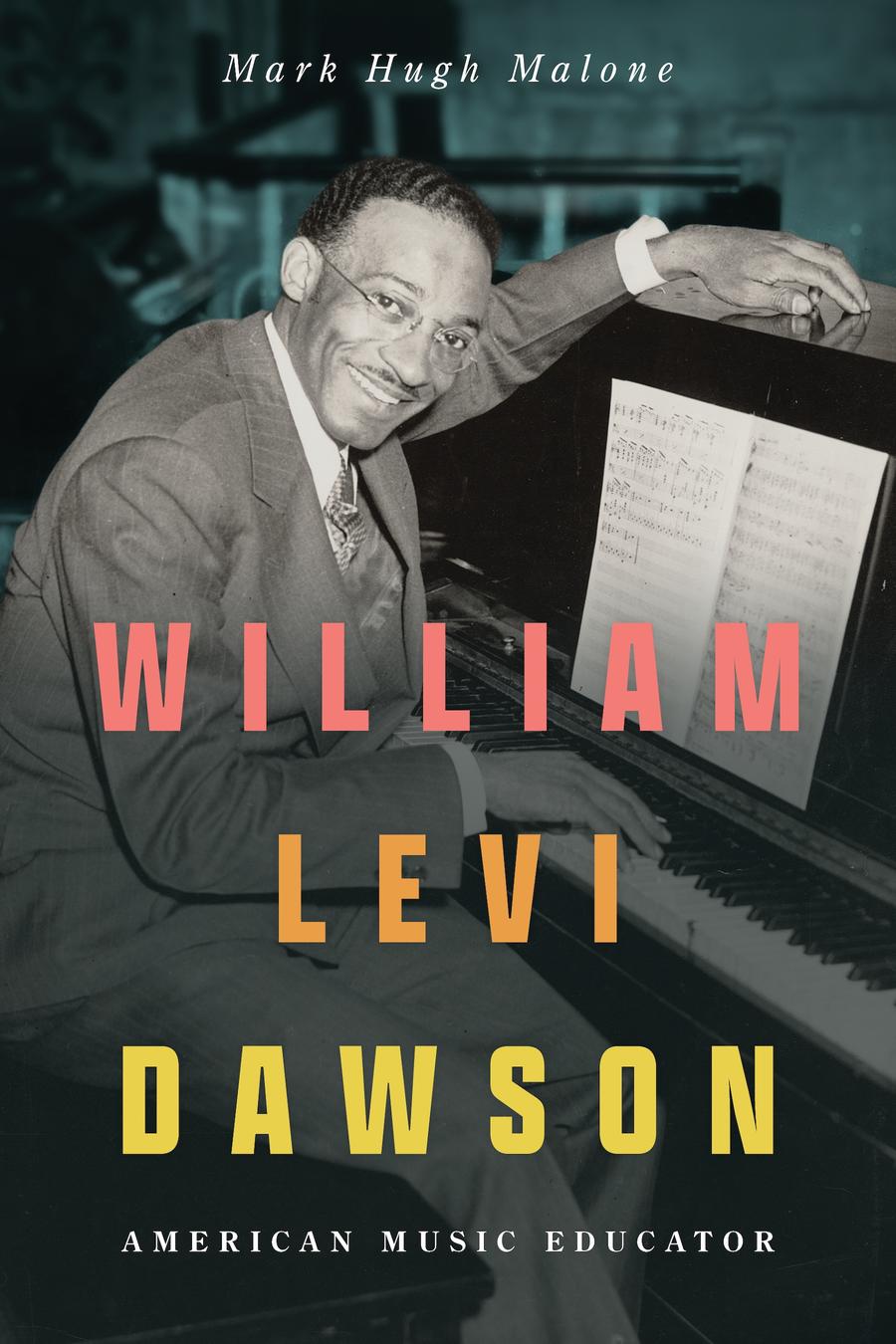
William Levi Dawson
American Music Educator
The story of a resolute African American composer and educator who flourished during the oppressive Jim Crow Era
Description
William Levi Dawson (1899–1990) overcame adversity and Jim Crow racism to become a nationally recognized composer, choral arranger, conductor, and professor of music. In William Levi Dawson: American Music Educator, Mark Hugh Malone tells the fascinating tale of Dawson’s early life, quest for education, rise to success at the Tuskegee Institute, achievement of national notoriety as a composer, and retirement years spent conducting choirs throughout the US and world.
From his days as a student at Tuskegee in the final years of Booker T. Washington’s presidency, Dawson continually pursued education in music, despite racial barriers to college admission. Returning to Tuskegee later in life, he became director of the School of Music. Under his direction, the Tuskegee Choir achieved national recognition by singing at Radio City Music Hall, presenting concerts for Presidents Herbert Hoover and Franklin D. Roosevelt, and performing on nationwide radio and television broadcasts.
Dawson’s Negro Folk Symphony, only the second extended musical work to be written by an African American, was premiered by Leopold Stokowski and the Philadelphia Orchestra in both Philadelphia and New York City. Dawson’s arrangements of spirituals, the original folk music of African Americans enslaved in America during the antebellum period, quickly became highly sought-after choral works. This biographical account of Dawson's life is narrated with a generous sprinkling of his personal memories and photographs.
Reviews
"In William Levi Dawson: American Music Educator Malone has provided not only a balanced account of a musician and educator, but he has also shown that the influence of an exceptional mentor reaches far past the lifetime of the advisor."
- Allison Chestnut, Signature Magazine
"William Levi Dawson: American Music Educator by Mark Hugh Malone is an impeccably well researched biography of a man who should be a household name, but somehow isn’t. . . . The book makes excellent and thoughtful use of author Malone’s interviews, as well as the personal memories and photographs of Dawson, his family, and peers to round out the person and the times. The biography tells an important story."
- Claire Matturro, Southern Literary Review
"According to an early music critic, choral music occurs when "a vocalist and an instrumentalist, each equally obstructed by the other, give themselves no end of trouble to produce a wretched result." The music of William Levi Dawson proves otherwise. In 1972, I first heard one of Dawson's choral arrangements. The Rebelaires conducted by Phyllis Merritt performed in the lobby of Baptist Hospital in Pensacola, FL. They sang Dawson's "Mary Had a Baby," and the beauty and mystery of that song replaced my anxiety about my hospitalized mother. I stayed for the rest of the concert. I was 15; SO years later his pieces still have that effect. If you've ever heard a choral concert, chances are good that you, too, have heard a few Dawson songs. Among his more frequently programed pieces are "Jesus Walked This Lonesome Valley;· "Ain-a That Good News;· "Ezekiel Saw de Wheel;' "King Jesus is A-Listenin'," "There is a Balm in Gilead," and "Swing Low, Sweet Chariot:· Dawson calls his pieces "Negro folk songs." People often refer to all his songs as spirituals, but as Mark Hugh Malone explains in his new biography "William Levi Dawson: American Music Educator" some of Dawson's works, for example "Jump Back, Honey, Jump Back" and "The Rugged Yank" are secular. While at The Florida State University, Malone completed a biography ofDawson as his dissertation in 1981. That Malone was able to interview Dawson in itself was a stoke of good luck As Malone explains, he was speaking about Dawson when a fellow student revealed that his father was Dawson's optometrist. Malone asked for an introduction to Dawson and soon found himself awash in primary sources. During the intervening 40 years, other than a few paragraphs or a chapter in a book on African American music, Malone's work was one of the few (if not the only) volume exploring exclusively William Dawson's life and work. Malone spent much of his career as a choral director at Pearl River
- Allison Chestnut, Signature Magazine
College, William Carey University, and various church and community choruses. In each venue, he programmed selections of Dawson's choral work, introducing new audiences and singers to the Dawson repertoire. Once he retired, he revised the dissertation material into a workable manuscript.
Although Malone's work originated as academic research, the book itself serves as a bridge between those who want an esoteric format and those who seek a more convivial narrative. For the scholar, Malone includes several appendices including a table of choral and orchestral compositions and arrangements (including
dates of original compositions and revisions and publishers); a list of awards, honors, and degrees; a selection of significant interviews, speeches, and letters; 25 pages of end notes; an annotated bibliography; and an index. Although not a musicologist, I enjoyed reading the letters and speeches, especially those penned by Ralph Ellison, the author of "Invisible Man" that won the 1953 National Book Award. Both Ellison and Dawson studied music at Tuskegee Institute in Alabama. Ellison left before graduating (but subsequently
taught at Rutgers). Dawson, who was mentored by Tuskegee founder Booker T. Washington, not only graduated, but he also returned to create the institution's department/school of music and remained a teacher and conductor at Tuskegee from 1931-1955. Other luminaries with whom Dawson worked include the poet artist Aaron Douglas, composer Harry T. Burleigh, French musician Nadia Boulenger, singer Paul Robeson, and conductor Leopold Stokowski. Malone also includes 18 pages of photographs. Of particular interest is a picture of a single flower petal. Malone had the opportunity to visit with Dawson on several occasions; Mrs. Dawson would often fix tea or a snack as Malone interviewed her husband. On one visit, Dawson told Malone
about the funeral of Booker T. Washington. After the funeral, the floral tributes were stacked inside the Tuskegee chapel, and Dawson collected a few blooms that he had given pride of place to in his home.
When Malone was taking his leave, Dawson gave Malone a single petal from the remaining few he had taken after the Washington funeral. In addition to the public Dawson, Malone provides a glimpse of Dawson the person. Dawson's father, George, was probably born into slavery and could neither read nor write. Dawson's mother, Eliza, however, was educated. William as the first of seven children was expected to help the family; George placed little value on education. Despite his father's dismissal oflearning, William received tutoring
in basic skills and music from sympathetic townsfolk. Often these lessons occurred after regular working
hours. William took odd jobs and apprenticeships and eventually saved enough money to catch a freight train to Tuskegee without his father's knowledge. After arriving at Tuskegee, he sat in classes to re mediate the gaps in his education. He made no excuses for his lack of preparation, and he expected students to share his
attitude. According to Ellison, Dawson's students called him a "wild son-of-a-gun." If the ensemble "members make a mistake he'll pick up the first thing handy and go up side their heads." As Malone emphasizes, Dawson never seemed to tire of learning and traveled to study in Chicago, St. Louis, and Paris, but a sabbatical from Tuskegee provided the means to fulfill his long-held dream to visit Africa. Like the "song catchers" who traveled the Appalachians with tape recorders in search of original songs, Dawson took one of the first tape recorders to study and record what he called the missing link in his arrangements and compositions. When he returned, he had captured the percussive patterns and acapella multipart songs. Malone notes that Dawson revised many of his pieces, often increasing the use and number of percussion instruments to incorporate a more authentic style of African folksongs. In ''William Levi Dawson: American Music Educator" Malone has provided not only a
balanced account of a musician and educator, but he has also shown that the influence of an exceptional mentor reaches far past the lifetime of the advisor."
"In William Levi Dawson: American Music Educator, Mark Hugh Malone has woven the first true narrative of Dawson's life. Relying on his hours of interviews with Dawson, Malone's meticulous research fills in the gaps to tell a complete story of one of the most iconic figures of twentieth-century American music. Here Malone lays out Dawson's early years in the segregated 1920s, his meticulous work with the Tuskegee Choir which caused him to quickly rise to national prominence, and his later years as an honored senior statesman of choral music in the United States. Malone lays out a compelling story of the difficulties Dawson faced earning an education, facing racism from critics, and persevering to serve his students and art. This book should be required reading for all Dawson devotees as well as scholars of spirituals."
- Vernon Huff, director of choral activities at the State University of New York at Fredonia